

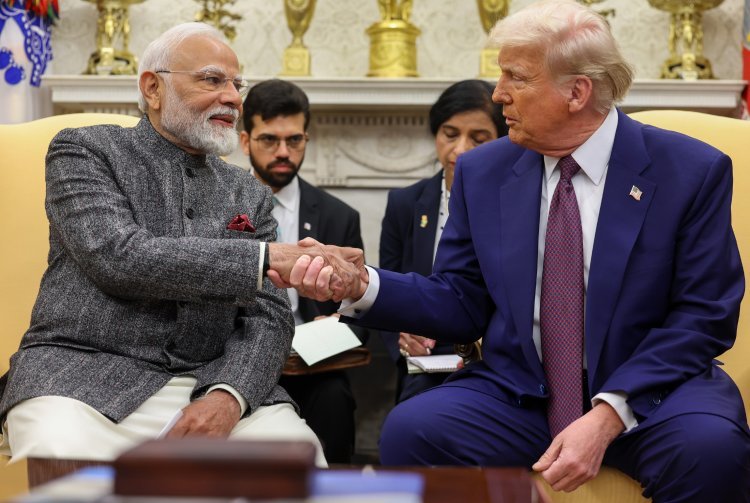
Since 2014, the visual narrative of India’s foreign policy has been dominated by one recurring theme: the deepening embrace between New Delhi and Washington. The images are familiar to anyone following global politics. We have seen Prime Minister Narendra Modi addressing a packed Madison Square Garden, walking hand-in-hand with Donald Trump at the “Howdy Modi” rally in Texas, and receiving a red-carpet state welcome from Joe Biden.
The diplomatic narrative suggests that the India-US partnership is stronger, deeper, and more consequential than at any point in history. Proponents argue that this alliance has elevated India’s global stature, placing it at the high table of international decision-making. High-visibility summits and warm personal chemistry between leaders are presented as evidence of a geopolitical triumph.
However, foreign policy must eventually be measured by a colder, harder metric than applause: economic security. When we look past the stadium events and the diplomatic pleasantries, a more complex and troubling picture emerges. For the Indian economy—specifically its exporters, farmers, and energy consumers—this “golden era” of relations has been marked by missed opportunities, punitive tariffs, and a loss of strategic leverage. It raises a fundamental question: has the prioritization of diplomatic optics come at the cost of tangible economic outcomes?
The Rise of Optics-Driven Diplomacy
The last decade has witnessed a shift in how India conducts its foreign engagements. Diplomacy, once a quiet affair conducted in closed rooms, has transformed into a spectator sport.
The Spectacle of Statecraft
The strategy relies heavily on mega-events designed to showcase India’s soft power and the personal popularity of its leader. The “Namaste Trump” event in Ahmedabad in 2020, where the former US President addressed a crowd of over 100,000 people, is a prime example. These events generate immense media coverage and project an image of two nations in perfect sync. They serve a dual purpose: signaling unity to global rivals like China, and bolstering domestic political support by portraying the Prime Minister as a globally revered figure.
Image Over Substance
While these spectacles are successful in generating headlines, they often disguise a lack of substantive progress on the economic front. Hard economic negotiation requires friction, compromise, and often, public disagreement. By prioritizing the image of a frictionless friendship, the administration has arguably limited its own room to manoeuvre. To maintain the optical success of the relationship, difficult conversations regarding market access, visa regimes, and trade barriers appear to have been deprioritised or postponed indefinitely. The hug has become the message, often obscuring the fact that the hands remain empty.
Trade Relations That Never Stabilized
For an emerging economy like India, the primary goal of a partnership with the world’s largest economy should be preferential market access. Yet, despite the soaring rhetoric, trade relations have remained rocky and unpredictable.
The Elusive Free Trade Agreement
Perhaps the most glaring failure is the absence of a comprehensive Free Trade Agreement (FTA). While India has successfully negotiated trade pacts with the UAE and Australia, a deal with the US remains a distant dream. American negotiators have consistently pushed for greater access to Indian markets for their agricultural and dairy products—demands that threaten the livelihoods of millions of Indian farmers.
In the absence of a structured agreement, trade is governed by ad-hoc decisions. The much-touted “Mini Trade Deal,” discussed extensively during the Trump administration, never materialised. Consequently, Indian exporters operate in an environment of uncertainty, unable to plan for the long term because the rules of engagement could change with a single executive order from the White House.
The Loss of Preferential Status
The most significant blow to Indian trade came in 2019, when the US terminated India’s designation as a beneficiary developing nation under the Generalized System of Preferences (GSP) programme. This scheme allowed duty-free entry for up to $5.6 billion worth of Indian exports. Its removal impacted thousands of Indian products, from textiles to engineering goods. Despite the “friendship,” this status has not been reinstated, leaving Indian exporters at a competitive disadvantage compared to rivals like Vietnam or Bangladesh.
Tariffs, Sanctions, and Economic Pressure
A true strategic partnership usually implies a degree of economic shielding. However, India has frequently found itself on the receiving end of American economic coercion, treated no differently than a hostile competitor.
The Steel and Aluminium Hit
Under the guise of national security—using the controversial Section 232 of the Trade Expansion Act—the US imposed heavy tariffs on steel and aluminium imports. This move hit Indian metal producers hard. Despite India’s status as a “Major Defence Partner,” it was not exempted from these punitive measures. While negotiations eventually led to some easing of these disputes at the World Trade Organization (WTO) recently, the years of lost revenue and market share cannot be recovered.
The Imbalance of Power
The dynamic reveals a stark power imbalance. Washington feels comfortable imposing unilateral measures on New Delhi, confident that India’s strategic need for the US (as a counterweight to China) outweighs its economic grievances. India, in turn, has often absorbed these economic blows to keep the strategic partnership afloat. This suggests that the relationship is not one of equals, but one where India pays an economic premium for strategic insurance.
Farmers and Exporters Left Exposed
The macroeconomic numbers on trade deficits often hide the human cost of these policy failures. It is the micro, small, and medium enterprises (MSMEs) and the agricultural sector that bear the brunt of unresolved trade issues.
Agriculture and Non-Tariff Barriers
Indian agricultural exports face significant non-tariff barriers in the US. Issues regarding phytosanitary standards often block Indian mangoes, grapes, and other produce from entering the American market. A robust trade negotiation would focus on harmonising these standards to boost rural incomes in India. Instead, without an institutional framework to resolve these disputes quickly, farmers lose out on lucrative export seasons.
The Plight of MSMEs
The withdrawal of the GSP affected labour-intensive sectors the most. Industries such as leather, gems and jewellery, and handlooms operate on thin margins. A tariff increase of even a few percentage points can render them uncompetitive globally. For the artisans and factory workers in India’s industrial hubs, the diplomatic chemistry in Washington has not translated into job security. In fact, the volatility has made their employment more precarious.
Energy Security Compromised
One of the most tangible costs of India’s alignment with US foreign policy interests has been the disruption of its energy security.
The Iran Factor
For decades, Iran was one of India’s most reliable and affordable sources of crude oil. The proximity meant low shipping costs, and Tehran often offered favourable credit terms. However, following the US withdrawal from the Iran nuclear deal, Washington imposed severe sanctions on nations trading with Iran.
Under threat of secondary sanctions, India reduced its oil imports from Iran to zero. This decision was a direct capitulation to US demands. The result? India was forced to buy oil on the volatility-prone global spot market or purchase more expensive American crude.
The Inflationary Impact
This shift had a cascading effect on the Indian economy. Higher oil import bills contributed to a widening current account deficit and fuelled domestic inflation. Every time an Indian citizen fills their petrol tank or buys vegetables transported by diesel trucks, they are paying a fraction of the price for India’s geopolitical alignment with the US. The strategic “friendship” forced India to abandon a cheap energy partner, with no mechanism from the US to compensate for the economic loss.
Strategic Autonomy vs Strategic Alignment
Historically, India prided itself on “Strategic Autonomy”—the ability to make independent decisions based solely on national interest. The current trajectory suggests a shift towards “Strategic Alignment,” which carries inherent risks.
Reducing Flexibility
By tethering its foreign policy so closely to Washington, India risks alienating other long-standing partners and the broader Global South. The ability to manoeuvre between power blocs—Russia, the US, and the Middle East—is diminished if New Delhi is perceived as a junior partner in an American alliance system.
Long-term Dependencies
Dependence creates vulnerability. Whether it is reliance on US technology standards, payment systems, or defence platforms, deep integration makes it harder for India to say “no” in the future. If the political winds in Washington shift—as they often do—India may find itself economically exposed with few alternative alliances to fall back on.
Who Benefited From the Friendship?
If the average exporter and energy consumer haven’t benefited, who has? The gains of this partnership have been concentrated in specific sectors.
The Defence and Tech Nexus
The primary beneficiaries have been the defence and technology sectors. American defence contractors have secured multi-billion dollar deals to supply India with helicopters, drones, and aircraft engines. Similarly, US tech giants have found an eager market and a source of talent in India.
Corporate vs. National Interest
While these deals modernise the Indian military and boost the IT sector, they do not necessarily generate broad-based employment or economic security for the wider population. The “trickle-down” effect of buying American drones is minimal for the rural economy. The friendship has undoubtedly served the interests of multinational corporations and the military-industrial complex, but its value to the common citizen remains debatable.
Domestic Accountability and Public Debate
Why has there been so little backlash regarding these economic outcomes? The answer lies in the management of the domestic narrative.
The government has been highly effective in separating economic realities from diplomatic optics. The media coverage focuses on the ceremonial honours bestowed upon the Prime Minister, framing them as a recognition of India’s arrival as a superpower. This “Vishwaguru” (Teacher to the World) narrative insulates the government from criticism regarding trade failures.
Opposition voices and industry bodies that raise alarms about export slowdowns or tariff barriers are often drowned out by the patriotic fervour surrounding these diplomatic summits. Consequently, the electorate rarely connects the high price of fuel or the closure of a textile unit to decisions made in the realm of foreign policy.
Could Outcomes Have Been Different?
It is worth asking if a different approach would have yielded better results. Other nations have managed to maintain robust economic ties with the US without surrendering their interests.
Vietnam, for instance, has absorbed a significant portion of manufacturing moving out of China, securing favourable terms despite having a completely different political system. Even China, despite its intense rivalry with the US, manages to leverage its market size to ensure American companies lobby against harsh decoupling.
India offers the world’s largest growing market. This is immense leverage. A more transactional approach—one that traded market access for concrete guarantees on visas, GSP restoration, and technology transfer—might have been less photogenic but more profitable. Diplomatic capital spent on securing a hug could have been spent on securing a tariff exemption.
Redefining Foreign Policy Success
The last decade of India-US relations offers a crucial lesson: warm embraces do not automatically translate into warm economies. While the optics of the partnership have been dazzling, the outcomes have been underwhelming for India’s economic security.
The loss of preferential trade status, the capitulation on energy sources, and the lack of market access for farmers paint a picture of a relationship where India gives strategically and receives only symbolically. Foreign policy cannot be an exercise in vanity; it must be a tool for national prosperity.
As India moves forward, it must recalibrate. The focus must shift from the pageantry of summits to the grit of negotiation. Real respect in the international arena comes not from how well a leader is received in a foreign capital, but from how well that relationship serves the citizens back home.
Join the Conversation
Do you believe India’s foreign policy is serving its economic interests? Subscribe to our newsletter for more in-depth analysis on geopolitics, trade, and the Indian economy.
Leave a Reply