

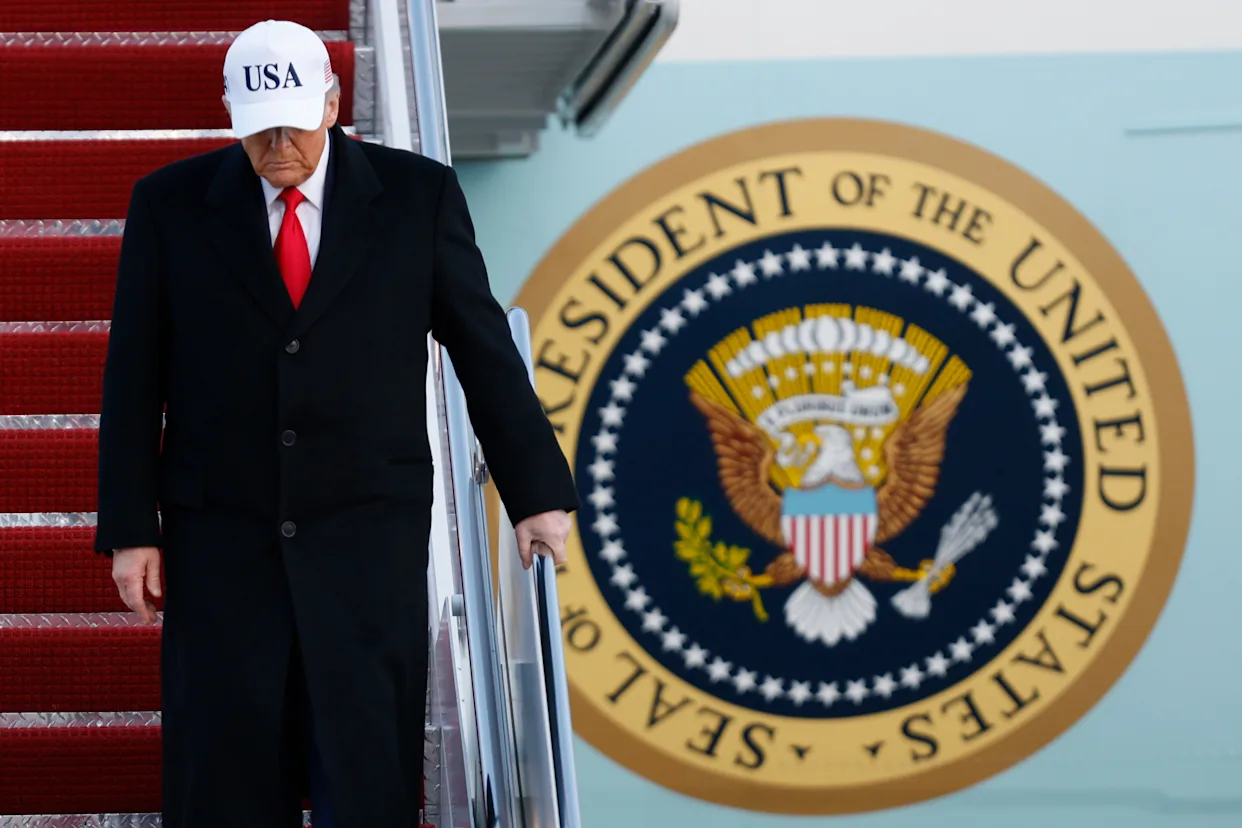
The atmosphere in the Senate chamber was thick with tension on a cold Wednesday in January 2026. What was meant to be a procedural confirmation of Congressional authority turned into a historic showdown over the limits of executive power. A bipartisan resolution aimed at restricting President Trump’s ability to launch further military actions against Venezuela without legislative approval stalled in a dramatic 50-50 tie.
It was Vice President J.D. Vance who cast the deciding vote, dismissing the resolution and effectively handing the White House a blank check for operations in South America. This wasn’t just a political victory for the administration; it was a flashpoint that has reignited a centuries-old debate.
This high-stakes legislative battle has shone a fresh, harsh light on a constitutional question that remains dangerously unresolved: Who truly controls the American war machine? As the dust settles on the vote, legal scholars, politicians, and citizens are forced to ask whether the system of checks and balances is functioning as the Founders intended, or if the power to wage war has permanently shifted to the Oval Office.
The Roots of the Conflict
To understand the gravity of the Venezuela vote, we have to look at the tug-of-war built into the foundation of the United States government. The Constitution creates a deliberate friction between the branches. Under Article I, Congress holds the sole power to declare war and fund military operations. However, Article II designates the President as the Commander-in-Chief of the armed forces.
For nearly two centuries, this ambiguity has led to clashes. The modern framework for this struggle is the War Powers Resolution of 1973. Passed in the wake of the Vietnam War over President Nixon’s veto, the law was designed to check the president’s power to commit the United States to an armed conflict without the consent of Congress.
The mechanism is supposed to be simple: the President must notify Congress within 48 hours of committing armed forces to military action and forbids armed forces from remaining for more than 60 days, with a further 30-day withdrawal period, without a Congressional authorization for use of military force (AUMF) or a declaration of war.
However, recent U.S. actions in Venezuela test these limits. Following a controversial military operation aimed at capturing Nicolás Maduro, critics argued the administration had bypassed the legislative branch entirely, engaging in acts of war under the guise of police action.
Anatomy of the Vote: January 2026
The path to the Vice President’s tie-breaking vote was paved with political maneuvering and sudden reversals. In the weeks leading up to the final tally, the Senate appeared ready to assert its authority. A bipartisan coalition had advanced the war powers resolution, driven by a shared concern that the Executive branch was dragging the country into a protracted conflict in South America without a public debate.
The resolution sought to explicitly restrict further military engagement in Venezuela unless Congress voted to approve it. For a moment, it seemed like a rare instance of institutional pride triumphing over party loyalty.
However, the political winds shifted rapidly between January 14 and 15. The White House launched an aggressive lobbying campaign. Republican Senators Josh Hawley and Todd Young, who had previously signaled openness to the resolution or support for Congressional oversight, reversed their positions. Citing assurances from the administration regarding the limited scope of future operations, they fell in line with the party leadership.
Their reversal resulted in the deadlock that allowed Vice President Vance to step in. His vote did more than just kill a bill; it signaled that, at least for now, the Senate is unwilling to challenge the President on the issue of Venezuela.
Constitutional Stakes: The Commander-in-Chief vs. The People’s House
The central issue is not just about policy in Venezuela, but about the erosion of the War Powers Clause. The Framers of the Constitution were terrified of a single executive having the power to drag the nation into war. They believed that such a grave decision should be made by the body most accountable to the people: the legislature.
Historically, presidents have pushed back against this, interpreting their “Commander-in-Chief” title as a broad grant of authority to protect national interests. From Harry Truman in Korea to Barack Obama in Libya, executives have used the justification of “police actions” or “limited kinetics” to bypass a formal declaration of war.
The Venezuela episode represents a new frontier in this expansion. By categorizing the capture attempt of a foreign head of state as a law enforcement or intelligence operation, the administration argues it falls outside the purview of the War Powers Resolution. If this interpretation stands, it creates a precedent where significant military engagements can occur indefinitely without a single vote is cast by an elected representative.
Why Supporters Demanded a Vote
For proponents of the resolution, the issue is clear-cut: unauthorized military acts weaken the rule of law. Democrats and a contingent of libertarian-leaning Republicans argued that the Constitution is not a suggestion. They contended that sending U.S. forces to capture a foreign leader is an act of war, regardless of how the administration labels it.
Their arguments focused on the danger of “endless wars.” Without a clear mission defined and authorized by Congress, military engagements tend to experience “mission creep.” What starts as a targeted raid can easily spiral into an occupation or a regional conflict.
Critics of the administration’s approach pointed out that the 60-day clock of the War Powers Resolution is meaningless if the President can simply claim that intermittent raids do not constitute “hostilities.” They viewed the vote as a necessary step to force the administration to articulate a strategy and seek public buy-in.
The Case for Executive Flexibility
Opponents of the resolution, however, painted a different picture. Their primary argument was operational reality. They stressed that there were no massive troop deployments or “boots on the ground” in the traditional sense of an invasion.
From this perspective, requiring Congressional approval for every special operations mission or targeted strike would cripple the military’s ability to respond to threats. They argued that the President needs the flexibility to act quickly against hostile regimes and that the operation against Maduro was a precise, limited action that did not rise to the level of “war.”
Furthermore, administration allies suggested that tying the President’s hands would signal weakness to adversaries. In their view, the vote was not about constitutional hygiene, but about undermining the President’s foreign policy leverage during a critical standoff.
Party Loyalty and Political Pressure
The collapse of the resolution highlights a significant reality of modern Washington: party loyalty often supersedes institutional power. The pressure campaign exerted by President Trump and his officials on Republican senators was intense.
The “flip” by Senators Hawley and Young demonstrates the difficulty of maintaining a consistent constitutional stance when it conflicts with the leader of one’s own party. War powers votes are rarely purely legalistic; they are political proxy wars. For a Republican senator to vote to limit a Republican president is often seen as a betrayal, inviting primary challenges and alienation from the party base.
This dynamic weakens Congress. If the legislative branch only asserts its war powers when the opposing party holds the White House, the power effectively ceases to exist as a constitutional check and becomes merely a partisan tool.
Ripple Effects on Global Foreign Policy
The outcome of this vote reverberates far beyond Caracas or Washington. It sends a message to the international community about how the United States intends to conduct itself.
If the U.S. government establishes that it can attempt to overthrow or capture foreign leaders without a democratic mandate, it complicates relationships with allies. NATO partners, for example, may be wary of supporting U.S. initiatives if they perceive them as impulsive executive actions rather than deliberated national strategies.
Furthermore, this precedent could embolden future presidents to intervene in other global hotspots—such as the South China Sea or Eastern Europe—using similar justifications. If the Venezuela standard applies, a wide range of military activities could be conducted without public debate, increasing the risk of accidental escalation into major power conflicts.
Is It Time to Reform the War Powers Resolution?
The stalemate has led many legal experts to conclude that the 1973 War Powers Resolution is broken. It is a law written for the era of Vietnam, ill-suited for an age of drone warfare, cyberattacks, and special operations raids.
Academics and reformers are calling for a new framework. Proposals include:
- Automatic Funding Cutoffs: Legislation that automatically cuts funding for unauthorized operations after a set period, removing the need for a veto-proof majority to stop a war.
- Defining “Hostilities”: Updating the language to explicitly include drone strikes, cyber warfare, and special ops raids, closing the loopholes administrations use to claim they aren’t “at war.”
- Joint Consultative Committees: Creating a permanent group of Congressional leaders who must be consulted before sensitive operations, ensuring secrecy is maintained while oversight is preserved.
Without structural reform, the cycle of executive overreach and legislative complaint is destined to repeat.
A Defining Moment
The tie-breaking vote by Vice President Vance may be remembered as the moment the Senate blinked. By failing to pass the resolution, Congress effectively ceded more territory to the executive branch, reinforcing the idea that the President has the unilateral authority to reshape the geopolitical map.
While the immediate crisis concerns Venezuela, the long-term casualty may be the system of checks and balances itself. As the definition of war blurs and political polarization paralyzes the legislature, the power to decide matters of life and death is concentrated in fewer and fewer hands.
Are We Witnessing the End of Congressional War Powers?
The debate over war powers is complex, but the stakes couldn’t be higher. To understand where this leaves American democracy, it helps to look at the most common questions surrounding this issue.
FAQs: Presidential War Powers and Congressional Oversight
What is the War Powers Resolution?
Passed in 1973, it is a federal law intended to check the U.S. president’s power to commit the United States to an armed conflict without the consent of the U.S. Congress.
Can a president conduct military actions without congressional approval?
Technically, yes, for a limited time. The president can send troops into action but must notify Congress within 48 hours. If Congress does not authorize the action within 60 days (or declare war), the forces are supposed to be withdrawn.
Why has Congress not declared war since World War II?
Modern conflicts often don’t fit the traditional definition of state-on-state warfare. Presidents and Congress have preferred “Authorizations for Use of Military Force” (AUMFs), which provide legal cover for military actions without the full diplomatic and legal ramifications of a formal declaration of war.
Does the recent vote signal broader constitutional trouble?
Many scholars argue yes. The inability of Congress to assert itself—even when a bipartisan majority initially agrees—suggests that the legislative branch has lost the political will to act as a co-equal branch on foreign policy matters.
Stay Informed on Constitutional Crises
The balance of power in Washington is shifting, and the consequences will define the next decade of American foreign policy. Don’t miss out on critical analysis as this story develops. Subscribe to our newsletter today to get deep dives and expert commentary delivered straight to your inbox.
Leave a Reply