

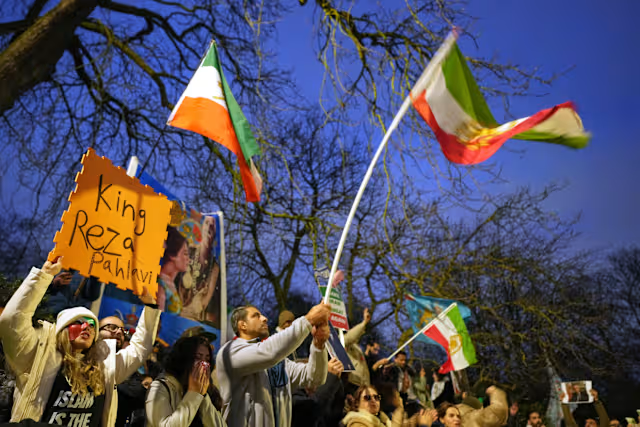
The geopolitical landscape of the Middle East is once again trembling under the weight of escalating tensions between Tehran and Washington. What began as a domestic crisis within Iran has rapidly metastasized into an international standoff, with rhetoric from both sides reaching fever pitch. As widespread protests continue to sweep through Iranian cities, the United States has intensified its warnings of potential intervention, prompting a sharp and dangerous rebuke from the Islamic Republic.
Iran has made its position unequivocally clear: any American military action will be met with swift retaliation. This warning extends beyond direct engagement with U.S. forces; Tehran has signaled that American bases hosted by regional allies could also be in the crosshairs. The stakes are incredibly high, involving not just the future of Iran’s internal politics, but the stability of the entire Persian Gulf region.
This article examines the rapidly evolving standoff, dissecting the causes, the military posturing on both sides, and the potential consequences of a conflict that neither nation can afford to lose. We will explore how internal unrest has fueled external aggression and what this means for global security.
Background: Unrest Inside Iran Fuels External Conflict Fears
To understand the current precipice, one must look at the events that ignited the fuse. Late in 2025, a wave of nationwide protests erupted across Iran, sparked by economic hardship and political grievances. By early 2026, these demonstrations had evolved into a sustained movement challenging the established order. The government’s response has been severe, characterized by a violent crackdown that has drawn international condemnation.
However, the internal narrative in Tehran has shifted from managing domestic dissent to countering what it perceives as foreign interference. Iranian leadership has repeatedly accused Western powers, specifically the United States, of orchestrating the unrest to destabilize the regime. This narrative serves a dual purpose: it attempts to delegitimize the protestors’ grievances by painting them as foreign agents, and it provides a pretext for a more aggressive military stance against external “enemies.”
Simultaneously, U.S. rhetoric has intersected sharply with this domestic turmoil. American officials have not only voiced support for the protestors but have also issued veiled threats suggesting that the international community—led by the U.S.—might not stand idly by if the violence against civilians continues. This verbal intervention has been interpreted by Tehran not as humanitarian concern, but as a prelude to regime change, effectively merging the domestic crisis with a looming international conflict.
Tehran’s Warning: Retaliation Against U.S. and Regional Bases
The most alarming development in this standoff is the scope of Iran’s threatened retaliation. In a series of official statements, high-ranking Iranian military commanders have warned that if Washington launches strikes, the battlefield will not be limited to the immediate aggressors. Instead, Tehran has expanded its threat matrix to include any regional country hosting American military assets.
This puts U.S. allies in a precarious position. Bases in Saudi Arabia, the United Arab Emirates, Turkey, and Qatar—critical hubs for American power projection in the Middle East—have been explicitly named as potential targets. The message from Tehran to its neighbors is stark: sovereignty will not protect you if you facilitate an attack on Iranian soil.
Diplomatic channels have reportedly been flooded with messages from Tehran to Riyadh, Abu Dhabi, and Ankara, urging them to prevent U.S. intervention. The implication is that hosting U.S. forces is a liability rather than a security guarantee. This strategy aims to fracture the U.S. alliance network by leveraging the fear of collateral damage among Gulf states, who have long worried about being caught in the crossfire of a U.S.-Iran war.
U.S. Military Posturing and Regional Precautions
In response to the heightened threat level, the United States has begun adjusting its military footprint in the region. While officially described as routine rotations or precautionary measures, recent movements suggest a heightened state of alert. Reports indicate that Washington has withdrawn non-essential personnel from certain vulnerable outposts in the Middle East, a move often associated with anticipation of conflict.
Strategic analysts speculate that U.S. forces are being repositioned to locations that offer better missile defense capabilities or are further out of range of Iran’s immediate arsenal. Naval assets in the Persian Gulf and the Arabian Sea remain on high alert, serving as both a deterrent and a potential launchpad for operations.
This posturing creates a complex paradox. On one hand, the U.S. must project strength to deter Iranian aggression and reassure allies. On the other hand, visible military build-ups can validate Tehran’s narrative of imminent invasion, potentially triggering the very conflict the U.S. claims it wants to avoid. The Pentagon is currently walking a tightrope, attempting to balance readiness with restraint.
U.S. Threats of Intervention
The language coming out of Washington has shifted from diplomatic concern to tangible threats. U.S. leaders have suggested that “all options are on the table” regarding Iran’s crackdown on protesters. This phrase, a staple of American foreign policy lexicon, carries heavy implications of military force.
Former President Donald Trump and current administration officials alike have framed potential intervention through the lens of human rights and regional stability. By positioning military action as a defense of the Iranian people against an oppressive regime, the U.S. attempts to build moral legitimacy for what would be a significant violation of national sovereignty.
However, critics argue that these threats may be counterproductive. History suggests that external threats often cause populations to rally around the flag, potentially strengthening the regime’s hand domestically. Furthermore, the lack of specific “red lines” creates ambiguity. It remains unclear what specific action by Tehran would trigger a U.S. kinetic response, leaving the region in a dangerous state of guessing games where a miscalculation could be fatal.
Diplomatic Signals and Suspended Engagement
As military tensions rise, diplomatic avenues appear to be closing. Tehran has reportedly suspended direct diplomatic contacts with Washington regarding the crisis, refusing to engage in back-channel talks that have historically been used to de-escalate flare-ups. This silence is deafening, removing the safety valve that often prevents skirmishes from turning into full-blown wars.
In the absence of direct U.S.-Iran dialogue, regional actors have stepped in to fill the void. Turkey, sharing a border with Iran and maintaining NATO ties, has been particularly active in diplomatic maneuvering. Ankara, along with envoys from Oman and Qatar, is working frantically to diffuse the escalation, carrying messages between the two adversaries.
These regional mediators are driven by self-preservation. They understand that a war between Iran and the U.S. would destabilize the entire neighborhood, disrupting economies, creating refugee crises, and potentially physically damaging their own infrastructure. The current diplomatic landscape is fractured, relying on third-party intermediaries to keep the peace while the principals refuse to talk.
Deterrence Strategy: Iran’s Military Outlook
Iran’s confidence in issuing such bold threats stems from a deterrence strategy it has cultivated for decades. Unlike conventional powers that rely on air superiority or massive standing armies, Iran relies on asymmetric warfare capabilities. Its defense posture is built around three pillars: a vast arsenal of ballistic and cruise missiles, a network of proxy militias across the region, and the ability to disrupt maritime traffic in the Strait of Hormuz.
Iranian officials have framed U.S. bases not as impregnable fortresses, but as “legitimate targets” sitting within striking distance. Their missile technology has advanced significantly, with improved precision and range capable of hitting targets throughout the Middle East.
Furthermore, Iran maintains deep influence over groups in Lebanon, Iraq, Syria, and Yemen. In the event of a conflict, these proxies could be activated to open multiple fronts against U.S. interests and allies simultaneously. This “forward defense” strategy is designed to make the cost of attacking Iran unacceptably high for the United States, forcing Washington to calculate whether a limited strike is worth a regional conflagration.
International Reactions to the Standoff
The global community is watching the Tehran-Washington standoff with growing alarm. European powers, signatories to previous nuclear agreements, have issued joint statements calling for maximum restraint. They find themselves in a difficult position: condemning the human rights abuses within Iran while simultaneously trying to prevent a U.S. military intervention that could shatter regional security.
Russia and China, traditional partners of Iran, have warned against “unilateral actions” by the United States. They view U.S. threats as an extension of Western hegemony and have signaled they would oppose any UN Security Council resolutions authorizing force.
The economic impact is already being felt. Global markets react volatility to uncertainty in the Persian Gulf, a critical artery for the world’s oil supply. Oil prices have seen fluctuations based on the severity of the daily rhetoric, with traders pricing in the risk of supply disruptions. Diplomatic pressure is mounting from energy-dependent nations in Asia and Europe, urging both sides to step back from the brink to avoid an energy crisis that could derail the global economy.
Possible Scenarios Going Forward
As we look ahead, several scenarios could unfold, ranging from an uneasy détente to open warfare.
- De-escalation via Third Parties: The most hopeful scenario involves successful mediation by regional actors like Qatar or Oman. This would likely require the U.S. to tone down interventionist rhetoric in exchange for Iran limiting its regional aggression, though the domestic unrest in Iran remains a wild card.
- Limited Military Exchange: A miscalculation—such as an accidental collision at sea or a proxy attack that kills American personnel—could trigger a limited U.S. strike. Iran would likely retaliate proportionately, leading to a tit-for-tat exchange that stops short of total war but keeps tensions at a boiling point.
- Expanded Regional Conflict: The worst-case scenario sees the U.S. launching a significant intervention, prompting Iran to unleash its full missile arsenal on regional bases and activate its proxies. This would draw Israel, Saudi Arabia, and Gulf states into a prolonged, devastating conflict.
This standoff will likely reshape future U.S.–Middle East policy. It highlights the diminishing returns of military threats in an era of asymmetric warfare and underscores the difficulty of influencing internal regime dynamics from the outside.
Frequently Asked Questions
Why is Iran threatening retaliation?
Iran views U.S. support for domestic protesters and threats of intervention as an existential danger to the regime. By threatening retaliation against U.S. bases and allies, Tehran hopes to raise the potential cost of any American action, effectively deterring an attack through the threat of mutual damage.
What military assets are at risk?
The primary targets would be U.S. military bases in the Persian Gulf region, specifically those in Bahrain (home to the Fifth Fleet), Qatar (Al Udeid Air Base), the UAE, and Saudi Arabia. Additionally, oil infrastructure and maritime shipping lanes in the Strait of Hormuz are considered vulnerable.
Has the U.S. already attacked Iran?
As of this report, the U.S. has not launched direct military strikes on Iranian soil in response to the current crisis. The confrontation remains at the level of verbal threats, diplomatic posturing, and military repositioning.
How could this confrontation affect global security?
A conflict could disrupt a significant portion of the world’s oil supply, leading to global economic instability. Furthermore, it could trigger a refugee crisis, draw in other global powers like Russia or China diplomatically, and increase the risk of terrorism if regional security vacuums are created.
A High-Stakes Geopolitical Standoff
The current tension between Tehran and Washington represents one of the most volatile moments in recent Middle Eastern history. What distinguishes this standoff is the convergence of intense internal instability within Iran with external geopolitical rivalries. Both nations are engaged in a high-stakes game of signaling: the U.S. is trying to project power to enforce human rights norms and protect interests, while Iran is leveraging its military capabilities to ensure regime survival.
The situation remains fluid. While diplomatic off-ramps exist, they are currently blocked by mistrust and aggressive rhetoric. It is imperative for the international community to continue monitoring developments closely, as the distance between a war of words and actual war is frighteningly short.
Are you concerned about the impact of geopolitical instability on your business or investments? Stay ahead of the curve with our daily global risk analysis.
Leave a Reply