

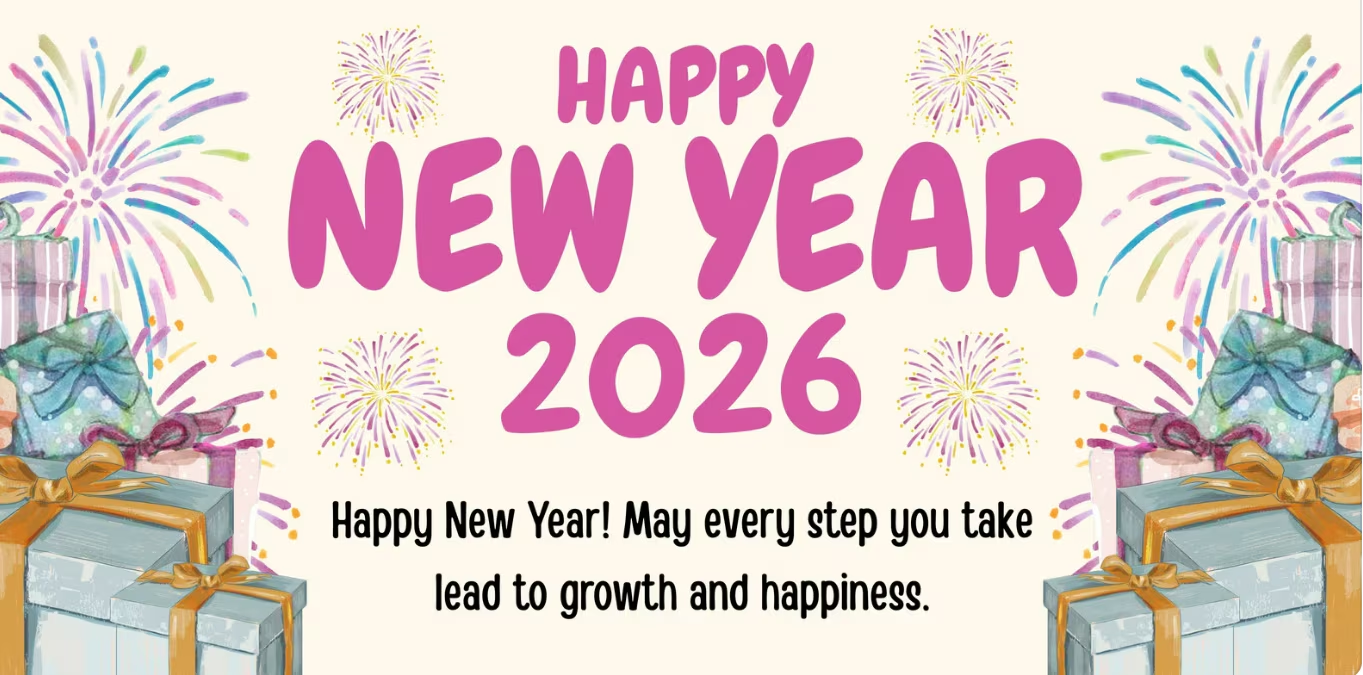
The clock strikes midnight, fireworks explode in a kaleidoscope of color, and millions of voices cheer in unison. It’s a scene repeated across time zones, languages, and borders. The arrival of a new year is perhaps the most universally shared human experience. It marks a moment where the past is acknowledged, but the future takes center stage.
While the core sentiment—hope for a fresh start—remains the same whether you are in Tokyo or Toronto, the methods of celebration vary wildly. Some cultures look outward with boisterous street parties and pyrotechnics, while others look inward with quiet prayer and reflection.
As we usher in 2026, the global mood feels particularly poignant. There is a collective desire for connection and renewal that transcends geographical boundaries. From the iconic ball drop in New York City to the tolling of temple bells in Kyoto, the world is welcoming 2026 with a blend of ancient tradition and modern flair. This guide explores the vibrant tapestry of global celebrations, highlighting how different regions are ringing in the new year.
Why New Year’s Celebrations Look Different Around the World
It might seem strange that a single event—the earth completing another orbit around the sun—can spark such diverse reactions. The reason lies in the deep-seated cultural, historical, and religious roots that anchor each society.
For many Western cultures, the New Year is secular, driven by the Gregorian calendar. It is a time for parties, champagne, and resolutions. However, for cultures following lunar or solar calendars, the “New Year” might fall in spring or autumn, meaning January 1st is celebrated differently, often with a mix of modern excitement and traditional restraint.
Time zones also play a massive role in how the global narrative unfolds. The “New Year” isn’t a single moment but a wave that sweeps across the planet over 24 hours. We watch Australia celebrate while Europe is still waking up, creating a rolling anticipation that builds throughout the day.
Despite these differences, there is a fascinating interplay between shared traditions and local customs. Almost everyone uses fireworks or noise to “scare away” the old year’s bad luck. Yet, what people eat, wear, or do in those first few minutes of January 1st is distinctly local.
New Year 2026 Celebrations by Region
As 2026 arrives, every corner of the globe has its own way of saying “Happy New Year.” Let’s look at how major regions are marking the occasion.
United States
In the United States, the celebration is synonymous with spectacle. The epicenter, of course, is Times Square in New York City. The Waterford Crystal ball drop is a tradition dating back to 1907, watched by millions on television and roughly a million freezing revelers in person. As the ball descends in the final minute of 2025, the energy is electric.
Beyond the Big Apple, Americans celebrate with massive house parties, club events, and community concerts. Fireworks displays light up skylines from Las Vegas to Miami. A distinct American tradition involves the “midnight kiss,” a superstition that suggests failing to kiss someone at the stroke of midnight foretells a year of loneliness.
For many, the festivities continue into New Year’s Day, often centered around sports. The Rose Parade in Pasadena, California, and a full slate of college football bowl games are staple viewing for families recovering from the night before.
United Kingdom
Across the Atlantic, London puts on one of the world’s most sophisticated pyrotechnic shows. The fireworks launch from the London Eye on the South Bank of the Thames, synchronized to a soundtrack of the year’s biggest hits. The chime of Big Ben at midnight is the defining sound of the British New Year.
The UK also has a strong tradition of “First Footing,” particularly in Scotland (where New Year’s Eve is called Hogmanay). The tradition dictates that the first person to enter a home after midnight brings luck for the coming year. Ideally, this person should be a dark-haired male bearing gifts like coal, shortbread, or whisky.
On New Year’s Day, many brave souls participate in icy swims in the coastal waters, a bracing way to wash off the old year and wake up for the new one.
India
India’s celebrations for January 1st are a fascinating mix of colonial history, global influence, and local culture. While India has several regional New Year celebrations based on Hindu, Sikh, and other calendars (often in March or April), January 1st is widely celebrated, especially in urban areas.
In metro cities like Mumbai, Delhi, and Bangalore, the scene mirrors Western celebrations: clubs are packed, hotels host gala dinners, and young people gather for countdown parties. However, there is a strong spiritual component for many families. It is common to visit a temple, church, or gurdwara on the morning of January 1st to seek blessings for the year ahead.
Family gatherings are central. Unlike the “party-hard” ethos of some Western countries, many Indians prefer intimate house parties with extended family, sharing rich meals and exchanging sweets.
Australia
Australia has the privilege of being one of the first major nations to welcome the New Year. Because it occurs during the Southern Hemisphere’s summer, the vibe is distinctly different from the wintry celebrations of the north.
Sydney Harbour hosts perhaps the most famous fireworks display in the world after New York. The bridge and opera house serve as the backdrop for a show that is broadcast globally, often setting the standard for the celebrations that follow.
For many Australians, New Year’s is an outdoor event. Beach parties, barbecues, and camping trips are standard. In places like Bondi Beach, thousands gather on the sand to dance and celebrate under the summer stars. It is a celebration of lifestyle as much as it is a celebration of time.
Japan
Japan offers a stark contrast to the noisy exuberance of the West. While there are countdowns in Tokyo’s Shibuya district, the traditional Japanese New Year, or Shogatsu, is a spiritual and family-centric holiday.
The most profound tradition is Joya no Kane. At midnight, Buddhist temples across the country ring their bells 108 times. This number represents the 108 worldly desires (such as anger, jealousy, and greed) that cause suffering. The ringing of the bell is believed to cleanse the soul of these desires for the coming year.
Many Japanese people visit a shrine or temple for Hatsumode, the first prayer of the year, usually wearing traditional kimono. Families gather to eat osechi-ryori, special boxed meals where every ingredient has a symbolic meaning for health, fertility, or prosperity.
Unique New Year Traditions Around the World
Beyond the fireworks and parties, there are countless quirky and meaningful traditions that people practice to ensure good fortune in 2026.
Food-Related Customs
What you eat when the clock strikes midnight matters.
- Spain: Locals eat 12 grapes in the 12 seconds leading up to midnight—one for each month of the coming year. If you finish them in time, you’re guaranteed luck.
- Southern USA: A meal of black-eyed peas and collard greens is essential. The peas represent coins, and the greens represent paper money.
- Philippines: Round shapes are associated with coins and wealth. Families display 12 round fruits and wear polka dots to attract prosperity.
Symbolic Rituals
Actions speak louder than words when it comes to New Year’s luck.
- Denmark: Friends and neighbors smash plates against each other’s front doors. A large pile of broken crockery on your doorstep in the morning indicates you are well-loved and have many friends.
- Latin America: In countries like Colombia and Mexico, people walk around the block carrying an empty suitcase. This ritual expresses a desire for travel and adventure in the upcoming year.
- Brazil: People head to the ocean to jump over seven waves, making a wish for each one. This is an offering to Yemanja, the goddess of the sea.
Clothing and Color Traditions
In many cultures, your underwear color dictates your fate.
- Yellow: Worn in many Latin American countries to attract money and prosperity.
- Red: Worn in Italy and Spain to attract love and passion.
- White: Worn in Brazil to bring peace and spiritual clarity.
How Social Media Is Shaping New Year 2026 Celebrations
Technology has fundamentally changed how we experience the New Year. It is no longer just a local event; it is a globally shared digital moment.
In 2026, social media platforms are the primary way people connect. Livestreams allow someone in London to watch the Sydney fireworks in real-time. Countdowns are shared instantly, creating a sense of a simultaneous global heartbeat.
Trending hashtags and “reels” or short-form videos dictate the aesthetic of the night. We see waves of similar content—recaps of the previous year, outfit transitions, and midnight reaction videos—flooding feeds. This creates a pressure to perform, to have the “perfect” celebration to broadcast to followers.
However, it also allows for virtual celebrations. For friends and family separated by oceans, video calls and virtual countdowns bridge the gap. Digital spaces have become just as important as physical venues for gathering and sharing well wishes.
Eco-Friendly and Low-Key New Year Trends in 2026
A shifting consciousness regarding the environment and mental health is influencing how people celebrate in 2026.
Sustainability is becoming a priority. Many cities are replacing traditional fireworks, which cause smoke pollution and stress to wildlife, with drone shows. These light displays offer the same visual spectacle without the noise or environmental fallout. Individuals are also opting for zero-waste parties, avoiding single-use plastics and glitter (which is a microplastic) in favor of biodegradable confetti.
There is also a growing trend toward “low-key” celebrations. The pressure to have an expensive, wild night out is fading for many. “JOMO” (the Joy of Missing Out) is real. More people are choosing mindful celebrations—meditation retreats, quiet dinners at home, or early nights to wake up fresh for a sunrise hike on January 1st. This shift reflects a desire to start the year with clarity and intention rather than a hangover.
One World, Many Celebrations
As we look toward 2026, the diversity of celebrations is a reminder of our shared humanity. Whether we are smashing plates in Denmark, eating grapes in Spain, or watching a ball drop in New York, the underlying motivation is identical. We all want to let go of the past’s hardships and step into the future with hope.
The methods may differ, but the spirit is universal. We seek prosperity, we seek love, and we seek peace. As the sun rises on January 1st, 2026, it illuminates a world that, despite its differences, is united in the hope for a better tomorrow.
Ready to start your year off right? Explore our full range of cultural guides and travel tips to make 2026 your most adventurous year yet. [Explore Now]
Frequently Asked Questions
How is New Year celebrated around the world?
Celebrations vary widely. Western cultures typically focus on parties, fireworks, and countdowns at midnight. Asian cultures often incorporate spiritual elements, such as visiting temples or shrines, alongside family meals. South American cultures have specific rituals for luck, such as wearing specific colors or burning effigies.
Which country celebrates New Year first?
The Pacific island nations of Tonga, Samoa, and Kiribati (specifically Kiritimati/Christmas Island) are the first places to welcome the New Year. They are followed shortly by New Zealand and Australia.
What are unique New Year traditions globally?
Some unique traditions include:
- Ecuador: Burning scarecrows filled with paper to destroy the past year’s bad luck.
- Greece: Hanging an onion on the front door as a symbol of rebirth.
- Turkey: Sprinkling salt on the doorstep as the bells ring to bring peace and abundance.
- Finland: Casting molten tin into water and interpreting the resulting shape to predict the future.
How are people celebrating New Year 2026 differently?
In 2026, there is a stronger emphasis on sustainability, with cities opting for drone shows over fireworks. There is also a shift toward digital connectivity, allowing for virtual celebrations, and a preference among younger generations for mindful, wellness-focused starts to the year rather than excessive partying.
Leave a Reply