

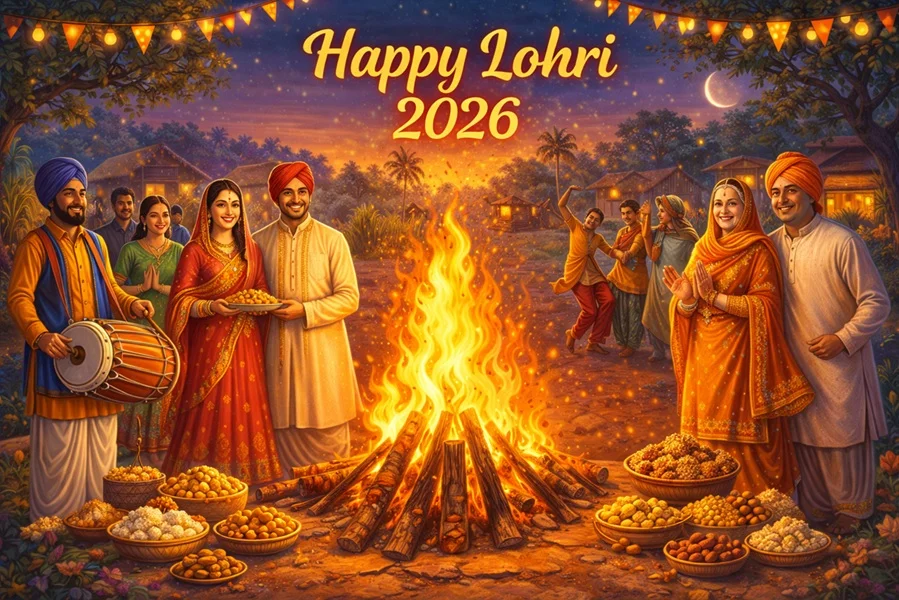
If you were to close your eyes and picture Lohri from twenty years ago, you would likely imagine a crisp January night in Punjab. The scene would be intimate: a small bonfire crackling in a residential courtyard, family members tossing in sesame seeds and jaggery, and the soft hum of folk songs sung by the elders. It was a festival of warmth, grounded in the earth and the harvest.
Fast forward to January 2026, and the picture has shifted dramatically. While the warmth remains, the scale has exploded. Lohri is no longer just a cosy winter ritual; it has transformed into a marquee event on India’s social calendar, rivalling Diwali and wedding season in its grandeur. From five-star banquet halls in Delhi to sprawling farmhouses in the posh outskirts of Chandigarh, the festival has shed its quiet skin to reveal a vibrant, high-energy avatar.
This shift isn’t merely cosmetic. It represents a fascinating evolution of Indian culture where tradition meets modernity head-on. As we navigate 2026, we are witnessing the “eventification” of our heritage, a new focus on gender equality within old customs, and a digital revolution in how we share our joy. Lohri has become a mirror reflecting the aspirations of a new India—one that wants to party like a global citizen while keeping its roots firmly planted in the soil of Punjab.
In this deep dive, we explore how the humble harvest festival has evolved into India’s newest social season, what this means for our cultural identity, and why this year’s celebrations are set to be the biggest yet.
The Changing Face of Lohri
The most striking difference in 2026 is the sheer magnitude of the celebration. The days of the neighbourhood bonfire—where residents would gather spontaneously with a bag of rewari and peanuts—are giving way to planned, curated spectacles.
The ‘Eventification’ of Tradition
According to recent reports from local media outlets like Dainik Bhaskar, banquet halls and event spaces across North India are booked out weeks in advance for Lohri. It is no longer enough to just light a fire; the fire must now be the centrepiece of a meticulously designed evening. We are seeing professional lighting setups that mimic concert venues, DJ consoles replacing the traditional dhol players (though the dhol often makes a cameo for the ‘authentic’ feel), and catering menus that rival royal weddings.
This “eventification” speaks to a broader trend in Indian society: the desire to turn every milestone into a shareable moment. Families are hiring event planners to manage guest lists that run into the hundreds. The intimate gathering has been replaced by the social gala, where networking happens over sarson da saag.
From Ritual to Statement
Why has this shift occurred? Part of it is economic. As disposable incomes rise, so does the desire to display prosperity. Hosting a grand Lohri party has become a status symbol, a way to announce one’s arrival in the social hierarchy. But it is also about connection. In an increasingly digital and disconnected world, these large-scale events force a physical gathering. They provide a reason for the diaspora to return home and for extended families to reunite, using the festival as the anchor for their annual social interaction.
The Social Revolution: Lohri for the Girl Child
Perhaps the most heartening evolution of Lohri in 2026 is the shift in who is being celebrated. Historically, Lohri had a strong patriarchal undertone. It was the festival of the “first son”—families would celebrate the birth of a male child or a new marriage with great pomp, while the birth of a daughter was often greeted with a quieter, private acknowledgement.
Breaking the ‘First Son’ Syndrome
That narrative is being rewritten. Reports from MP Info and other regional news sources highlight a massive surge in “Beti Ki Lohri” (Lohri for the daughter). In 2026, the birth of a girl child is celebrated with the same, if not greater, enthusiasm as that of a boy. The grand parties and the huge bonfires are now just as likely to be in honour of a newborn daughter.
This is a profound cultural correction. It signifies that the festival is no longer just about carrying forward the lineage in the traditional sense, but about celebrating the child, regardless of gender.
Empowerment in Rural and Urban India
This change isn’t limited to progressive urban pockets. Even in rural heartlands, where traditions are often more rigid, community leaders and panchayats are encouraging the celebration of girls. We are seeing community Lohri events specifically dedicated to families blessed with daughters in the past year.
By reclaiming the festival as a platform for gender equality, India is proving that traditions are not static. They can be moulded to reflect modern values without losing their essence. The bonfire now burns as a symbol of enlightenment and equality, purging the old biases of the past.
The ‘Theme-Party’ Culture: Village Vibe in a Luxury Setting
There is a distinct irony in how urban India celebrates Lohri in 2026. As people move further away from village life, the craving for “authenticity” grows stronger. This has given birth to the “Pind” (village) theme party—a luxury recreation of rural Punjab inside modern, air-conditioned venues.
Recreating the Roots
Event planners are charging a premium to transport guests back to a romanticised version of the village. Five-star hotels in metros are transforming their ballrooms into rustic courtyards.
- Decor: The use of phulkari (traditional embroidery) backdrops is ubiquitous. We see vibrant dupattas draped across ceilings, marigold garlands, and the strategic placement of charpais (woven beds) for seating.
- The Food Stalls: The standard buffet is out. In its place are traditional rehris (wooden carts) serving piping hot delicacies. It’s about the theatre of food—watching the makki ki roti being patted out by hand and the jaggery bubbling in large iron vats.
- The Instagrammable Pit: The bonfire itself has had a makeover. It is no longer a haphazard pile of wood but a designed element, often contained in ornate fire pits that allow for safe, smoke-controlled burning, perfect for that slow-motion Instagram reel.
The Kitsch Factor
Is it kitsch? Perhaps. But it also represents a genuine longing for connection to the land. For the IT professional in Gurugram or the banker in Mumbai, this manufactured village vibe is their bridge to a culture they may only remember from childhood stories. It preserves the aesthetics of the culture, ensuring that symbols like the charkha (spinning wheel) and the kite remain recognisable to the next generation, even if they encounter them as props rather than tools of daily life.
A Digital Connection: The Language of Wishes
While the physical parties have become grander, the emotional core of Lohri—the exchange of blessings and goodwill—has migrated to the digital realm. In 2026, the language of the festival is as much binary code as it is Punjabi dialect.
The Viral Greetings of 2026
The morning of Lohri is now defined by the notification ping. But the generic “Happy Lohri” text is a thing of the past. As noted in coverage by outlets like Aaj Tak, there is a rising trend of sharing Hindi and Punjabi poetry, intricate digital cards, and video messages.
The legend of Dulla Bhatti—the Robin Hood-like figure of Punjab who is central to Lohri folklore—is experiencing a digital renaissance. Influencers and content creators are producing short films and Reels retelling the story of how he rescued girls from the slave market and arranged their marriages. These snippets of history are shared widely on WhatsApp family groups, keeping the folklore alive for a generation that consumes history in 60-second bites.
Virtual Bonfires
For those who cannot make it home, technology bridges the gap. We are seeing families set up large screens near the physical bonfire so that relatives abroad can “join” the circle via video call. The warmth of the fire is transmitted across time zones, proving that while the medium has changed, the message of togetherness remains indelible.
The ‘Global Village’ Effect
Lohri was once geographically confined to Punjab, Haryana, and parts of Himachal Pradesh. In 2026, it is truly a pan-Indian, and indeed global, phenomenon.
Beyond the North
Migration has carried the festival to every corner of India. In Bengaluru, the IT capital, large Punjabi communities host massive Lohri events that attract locals from all backgrounds. It has become a cosmopolitan celebration of winter and harvest, transcending linguistic barriers. The rhythm of the dhol resonates just as loudly in Koramangala as it does in Ludhiana.
The Diaspora Connection
Globally, the scale is even more impressive. In cities like Brampton, Canada, or Southall, UK, Lohri celebrations are public events supported by local councils. They serve as a “Global Harvest Festival,” linking the Non-Resident Indian (NRI) community back to their roots.
For the diaspora, Lohri is a critical cultural anchor. It is a day to wear traditional attire, speak the mother tongue, and introduce their children to the customs of their ancestors. The festival has become a soft power tool, exporting the vibrancy of Indian culture to the world stage. In 2026, you are just as likely to see a Lohri bonfire in a snowy Toronto park as you are in a foggy Jalandhar field.
The Eternal Flame
As we look at Lohri in 2026, it is easy to be cynical about the commercialisation. The luxury venues, the designer outfits, and the professionally managed events can seem far removed from the festival’s humble agrarian origins. However, if we look closer, we see that the heart of Lohri beats as strong as ever.
The fire still burns to ward off the cold. The sesame and jaggery still remind us to speak sweetly to one another. And the gathering of people—whether in a village square or a banquet hall—still serves the same purpose: to foster community, to celebrate life, and to offer gratitude for the harvest.
The manner of celebration has undoubtedly changed. We have swapped the street corner for the theme party. But the meaning has not just survived; it has thrived. It has expanded to include daughters, it has embraced technology, and it has travelled the globe.
So, this January 13th, whether you are tossing popcorn into a fire pit at a luxury hotel or lighting a small flame on your balcony, know that you are part of a living, breathing tradition.
Ready to celebrate in style?
If you are looking to create the perfect traditional look for your Lohri party this year, or simply want to understand the roots of the festival better, explore our curated collection of festive essentials. Browse the Lohri Collection Here and keep the flame of tradition burning bright.
Leave a Reply