

It’s a headline that stops you in your tracks: nine billion dollars. In a state like Minnesota, known for its civic engagement and robust social services, an allegation of fraud reaching that magnitude isn’t just a scandal—it’s an earthquake. Recently, social media feeds and local coffee shops have been buzzing with rumors, viral videos, and heated political debates centering on this staggering figure.
But in the age of rapid-fire information, separating the signal from the noise is difficult. Is there really a $9 billion hole in the state budget? Are federal agents knocking on the Governor’s door? Or is this a case of misinterpreted data spiraling into a political firestorm?
This article breaks down the complex web of allegations surrounding Minnesota’s fraud controversy. We will look at the timeline of events, the specifics of federal investigations, the political fallout for Governor Tim Walz, and the critical difference between verified facts and viral speculation. By the end, you will have a clear understanding of what is actually happening in the North Star State.
What Sparked the Controversy
Every major news story has an ignition point. In this case, it wasn’t a press conference or a court filing, but a digital wildfire that started on social media.
Viral video claims about daycare fraud
The controversy gained significant traction following the release of videos alleging massive fraud within Minnesota’s daycare assistance programs. These videos, circulated widely on platforms like X (formerly Twitter) and Facebook, claimed that billions of taxpayer dollars were being siphoned off by fraudulent daycare providers. The narrative suggested that money meant for low-income families was being sent overseas or used to fund illicit activities.
Initial public reactions and social media spread
The reaction was immediate and visceral. Taxpayers were rightfully outraged at the prospect of such colossal mismanagement. The videos tapped into existing anxieties about government waste and corruption. Within days, the hashtags related to Minnesota fraud were trending, and the story had leaped from niche political blogs to mainstream conversation. The emotional weight of the accusations—involving children’s welfare and public funds—made the content highly shareable.
Clarifying the origin of the $9 billion figure
The most shocking element of the story is the “$9 billion” price tag. However, it is crucial to understand where this number comes from. It does not appear in a single audit report as a confirmed loss. Instead, critics and commentators have aggregated potential fraud, waste, and mismanagement across various sectors over several years, or extrapolated findings from smaller samples to the entire budget. Understanding the calculation behind this figure is essential to analyzing the validity of the claims.
Timeline of Key Events
To understand the current situation, we must look at how the narrative evolved from a local concern to a national headline.
First reports and viral spread
The timeline begins with early legislative auditor reports that flagged issues with the state’s oversight of the Child Care Assistance Program (CCAP). While these initial reports were concerning, they did not allege fraud in the billions. The narrative shifted dramatically when the viral videos emerged, amplifying the scale of the alleged mismanagement and introducing the $9 billion figure into the public lexicon.
Official statements from authorities
As the rumors reached a fever pitch, state agencies were forced to respond. The Minnesota Department of Human Services (DHS) released statements attempting to contextualize the audit findings. They acknowledged gaps in oversight but vehemently denied the scale of fraud portrayed in the viral content. This created a friction point: a public convinced of a massive scandal versus a bureaucracy insisting on nuance.
Federal involvement and escalating news coverage
The situation escalated from a state administrative issue to a potential criminal matter when news broke of federal interest. Subpoenas were issued, and it became clear that the FBI and other federal entities were looking into specific programs. This involvement legitimized the concerns for many observers, proving that the smoke was indeed coming from a fire, even if the size of the fire was still being determined.
Subsequent developments and updates
Since the initial explosion of interest, the story has seen daily developments. Legislative hearings have been held, additional audits have been requested, and political action committees have begun using the allegations in campaign materials. The timeline is still being written as new evidence comes to light.
Federal Investigations Explained
The phrase “under federal investigation” carries immense weight. But what does it actually mean in this context?
Agencies involved (FBI, DHS, U.S. Attorney’s Office)
Multiple federal bodies are reportedly looking into Minnesota’s handling of public funds. The Federal Bureau of Investigation (FBI) is the primary agency associated with criminal probes. Additionally, the U.S. Attorney’s Office plays a critical role in prosecuting federal crimes. There is also involvement from federal inspectors general who oversee the Department of Health and Human Services funds at the national level.
Purpose and scope of the investigations
The core purpose of these investigations is to determine if federal laws were broken. Specifically, investigators are looking for evidence of wire fraud, theft of public money, and money laundering. The scope typically involves following the money trail: seeing exactly where grant money went, who received it, and if the services paid for were actually provided.
What authorities are looking into
Authorities are not necessarily looking for a single $9 billion lump sum. Instead, they are investigating specific networks of providers and verifying enrollment numbers. They are checking if daycare centers claimed to care for children who were not there, or if they inflated attendance records to receive higher reimbursements.
Clarification on what is and isn’t confirmed
It is vital to note that an investigation is not a conviction. As of this writing, federal authorities have not confirmed the “$9 billion” fraud figure. They have confirmed active investigations into specific fraud schemes, such as the Feeding Our Future scandal (which involved hundreds of millions, not billions), but the broader claims linking widespread government complicity to a $9 billion loss remain under scrutiny.
How Minnesota Officials Responded
The executive branch of Minnesota’s government has been on the defensive since the allegations surfaced.
Statements from Gov. Tim Walz
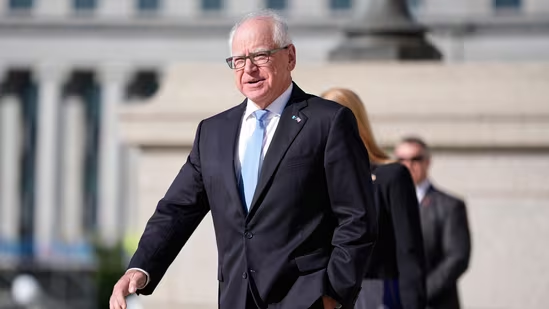
Governor Tim Walz has addressed the allegations by emphasizing his administration’s commitment to accountability. In press conferences, he has highlighted the steps his administration has taken to tighten oversight and prosecute bad actors. He has characterized the viral claims as politically motivated attacks designed to destabilize the state government ahead of election cycles.
Clarifications from state agencies
The Minnesota Department of Human Services (DHS) has been the focal point of the controversy. Their leadership has issued technical corrections to the viral narratives. For example, they have explained the difference between “improper payments” (which can be paperwork errors) and “fraud” (which is intentional theft). They argue that conflating the two exaggerates the problem.
What has been verified vs. misinformation
State officials have verified that fraud exists. The Feeding Our Future case is a prime example where the state stopped payments and alerted the FBI. However, officials dispute the idea that the entire social safety net is corrupt or that the Governor is personally directing a massive cover-up. They maintain that the systems are working to catch fraud, even if they aren’t perfect.
Political Fallout and Reactions
In a polarized political climate, allegations of this magnitude inevitably become campaign weapons.
GOP legislators calling for Gov. Walz’s resignation
Republican legislators in Minnesota have seized on the issue, using it as a primary line of attack. Several prominent GOP members have called for Governor Walz to resign, arguing that the alleged fraud occurred on his watch and represents a catastrophic failure of leadership. They contend that the administration was either complicit or grossly incompetent.
Arguments from critics vs. responses from supporters
Critics argue that the sheer volume of smoke—the audits, the federal subpoenas, the confirmed cases—proves a systemic failure. They believe the state government has grown too large to manage effectively. Supporters of the Governor counter that fraud is being actively prosecuted and that the administration is transparent. They argue that the GOP is weaponizing a criminal investigation for political gain, ignoring the fact that the state itself blew the whistle on several fraud rings.
Impact on Minnesota’s political landscape
This controversy has shifted the political ground in Minnesota. Fiscal responsibility and public safety have moved to the forefront of the debate. It has put the ruling DFL (Democratic-Farmer-Labor) party on the defensive regarding budget management, potentially tightening the margins in upcoming legislative races.
Separating Fact from Fiction
In the storm of accusations, truth is often the first casualty. Here is a breakdown of what we know versus what is being claimed.
Verified facts vs. misleading social media claims
- Verified: There is a massive, confirmed fraud case involving the Feeding Our Future non-profit, totaling roughly $250 million.
- Verified: The Legislative Auditor has found significant issues with DHS oversight over the years.
- Misleading: The claim that $9 billion has been stolen is not supported by current documentation or criminal charges. This figure appears to be a conflation of total program budgets or speculative extrapolation.
- Misleading: Social media posts claiming the Governor has been indicted are false.
Expert commentary on fraud, data, and interpretations
Forensic accountants and legal experts warn against accepting viral numbers at face value. They explain that in large government budgets, “questioned costs” in an audit do not automatically equal fraud. A missing receipt is a compliance issue; a fake receipt is fraud. Experts suggest that while the verified fraud is serious, the $9 billion figure likely vastly overstates the criminal reality.
Role of misinformation in escalating political tensions
Disinformation researchers point to this story as a case study in how complex administrative issues are weaponized. By attaching a shocking number ($9 billion) to a complex issue (grant oversight), bad actors can generate outrage that bypasses critical thinking. This escalates tension, making bipartisan solutions to actual fraud more difficult to achieve.
How This Affects Minnesota Residents
Beyond the political theater, real people are impacted by these allegations and the subsequent investigations.
Impact on public trust in government and services
The most immediate casualty is trust. When citizens believe their tax dollars are being stolen, faith in public institutions crumbles. This cynicism makes it harder for the government to pass budgets or launch new initiatives, as the public assumes the worst about how the money will be managed.
Daycare providers and community concerns
Honest daycare providers—the vast majority of the industry—are caught in the crossfire. Increased scrutiny and tighter regulations, implemented in response to the fraud, create administrative burdens for small business owners. Many fear that the stigma of “daycare fraud” will unfairly tarnish the reputation of legitimate care providers.
Broader implications for social programs
There is a risk that the scandal will be used to justify broad cuts to social safety nets. If the public perceives these programs as rife with abuse, political support for funding them diminishes. This could ultimately hurt the low-income families who rely on food and childcare assistance the most.
National Coverage and Media Response
Minnesota is usually known for “Minnesota Nice,” not massive corruption scandals. The national media has taken notice.
How major news outlets are reporting the issue
National outlets like The New York Times and The Wall Street Journal have covered the specific, confirmed fraud cases like Feeding Our Future. Their reporting tends to be more cautious regarding the “$9 billion” figure, focusing instead on the verified $250 million theft and the systemic failures that allowed it.
Differences in local vs. national narratives
Local media in the Twin Cities has been in the trenches, covering every audit and committee hearing. Their coverage is granular and detailed. National media, conversely, often frames the story as part of a larger trend of pandemic-relief fraud occurring across the country.
Why this story resonates beyond Minnesota
This story resonates nationally because it touches on universal themes: the stewardship of taxpayer money and the vulnerability of emergency relief funds. As the federal government poured trillions into the economy during the pandemic, questions about where that money went are being asked in every state. Minnesota just happens to be the current epicenter of that inquiry.
What Happens Next
The story is far from over. Here is what to look for in the coming months.
Expected developments in the federal probe
Federal investigations move slowly, but they grind exceedingly fine. We can expect further indictments related to the specific fraud rings already identified. Whether the investigation expands to implicate high-level state officials remains the key unanswered question.
Political ramifications for upcoming elections
As the election cycle heats up, expect to see “The $9 Billion Fraud” on mailers and TV ads. The outcome of the investigations will likely determine whether this issue sinks the current administration or if they can successfully argue that they cleaned up the mess.
What to watch for in future updates
Keep an eye on the U.S. Attorney’s press releases. These are the source of verified facts regarding criminal charges. Also, watch for future reports from the Office of the Legislative Auditor, which will provide non-partisan assessments of the state’s progress in fixing oversight gaps.
FAQs (SEO Booster)
What are the Minnesota $9 billion fraud allegations about?
The allegations stem from claims that billions of taxpayer dollars were stolen through fraud in state programs, particularly childcare and food assistance. While verified fraud in the hundreds of millions has been found (such as the Feeding Our Future scandal), the $9 billion figure is widely disputed and not confirmed by official audits.
Is Gov. Walz under investigation?
Currently, there is no public confirmation from federal authorities that Governor Tim Walz is personally under criminal investigation. The investigations are focused on the individuals and organizations that allegedly stole the funds and the departmental oversight failures.
What triggered the federal probe?
The federal probe was largely triggered by the massive scope of the Feeding Our Future scheme, where a non-profit allegedly misappropriated $250 million in federal child nutrition funds. This drew the attention of the FBI and the U.S. Attorney’s Office.
Are the daycare fraud videos verified?
Many of the viral videos circulating on social media contain unverified claims and conflate different issues. While there have been documented instances of daycare fraud in Minnesota, the specific claims made in some viral content regarding the scale and destination of the money remain unsubstantiated by law enforcement.
Conclusion
The allegations of fraud in Minnesota represent a complex intersection of crime, politics, and public administration. While confirmed cases like the Feeding Our Future scandal reveal serious vulnerabilities in how the state manages public funds, the narrative of a $9 billion conspiracy remains, for now, unproven by official sources.
It is crucial for residents and observers to distinguish between the confirmed theft of hundreds of millions—which is bad enough—and the viral speculation of billions. As federal investigations continue, the full truth will eventually come to light. Until then, relying on verified reporting rather than social media rumors is the best way to stay informed.
Stay updated on this developing story. Subscribe to our newsletter for the latest breakdowns on state politics and investigative reports.
Leave a Reply